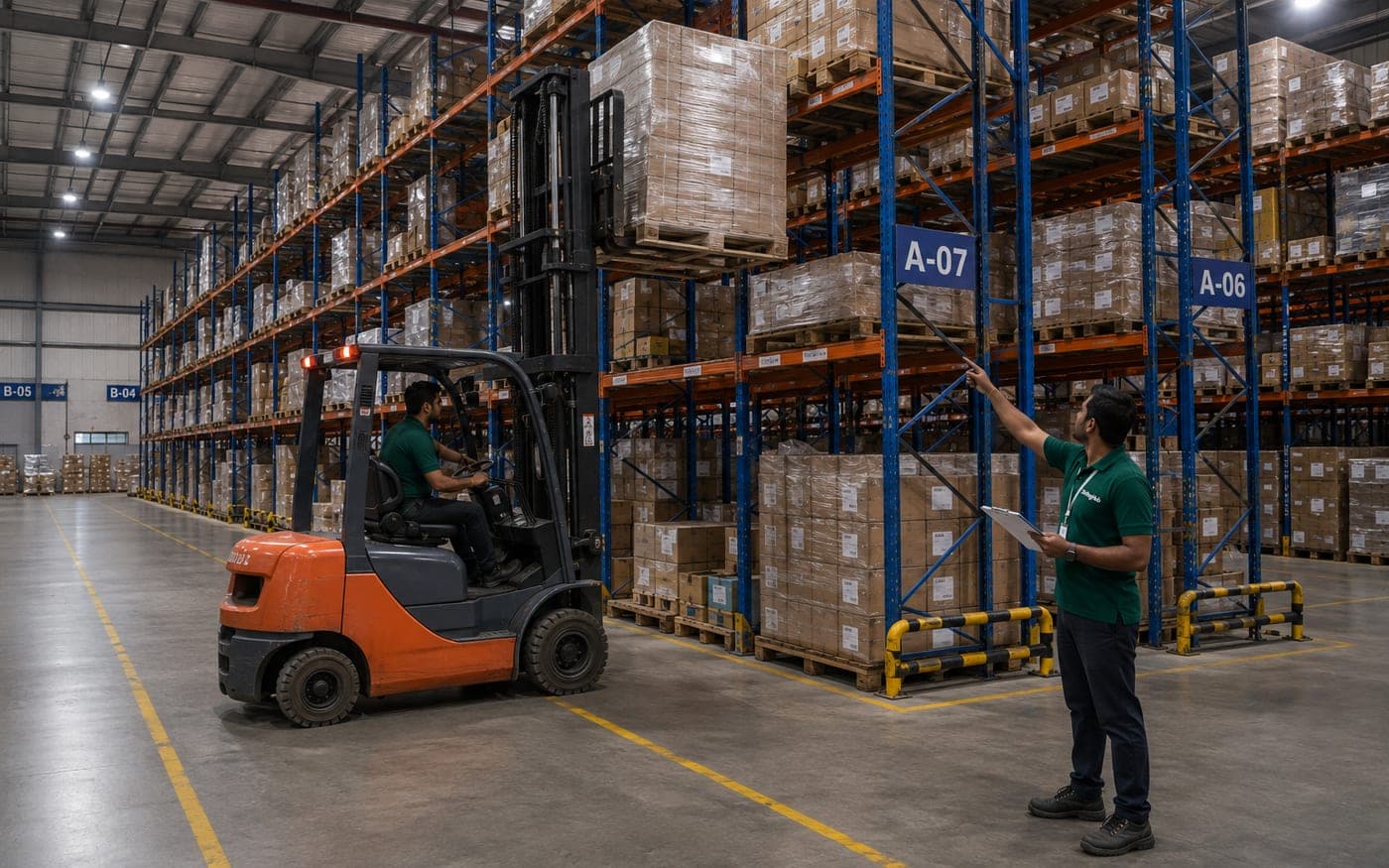
Warehouse & B2B Storage
Our warehouse partners offer managed B2B storage with digital inventory tracking, pick-and-pack fulfilment, and flexible terms. No lock-in contracts.
Get a Free QuoteWhat's included
- Managed pallet & bulk storage
- Digital inventory catalogue
- Pick-and-pack fulfilment
- 24/7 CCTV & access control
- Flexible weekly to annual plans
- Pan-city distribution support
How it works
- 01
Requirement Assessment
We assess your SKU count, volume, and inbound/outbound frequency.
- 02
Space Allocation
A dedicated bay or pallet zone is assigned in the nearest facility.
- 03
Inbound & Cataloguing
Goods are received, counted, and logged into your digital inventory.
- 04
Dispatch on Demand
Request a pick-and-pack or full-pallet dispatch whenever needed.
Verified partners for warehouse & b2b storage
A sample of our verified network. Compare all of them on the partners page.







Managed warehousing for growing businesses
Storing business inventory well means more than finding a big enough room. It means knowing exactly what's on the shelf, being able to dispatch an order the same day it comes in, and not being locked into a five-year lease for space you might outgrow in six months. Warehouse and B2B storage through ShiftingHub covers managed pallet and bulk storage with digital inventory tracking, so stock levels are visible without a phone call. It suits everything from an e-commerce business needing pick-and-pack fulfilment to a manufacturer holding finished goods before distribution. Safety comes through 24/7 CCTV and access control at the facility, plus insurance on stored inventory. Transparency shows up in flexible, no-lock-in contracts, priced by space and frequency of movement rather than a rigid long-term commitment.
Why choose ShiftingHub for warehousing
Business storage needs change as fast as the business does, which is exactly why flexibility matters as much as space.
- Facility partners are background-checked, GST-verified, and physically audited before listing.
- Multiple quotations by space and SKU count, not a generic per-square-foot rate.
- Transparent, no-lock-in pricing that scales with your actual inventory movement.
- Comparing facilities rather than the nearest option can meaningfully reduce ongoing cost.
- A nationwide distribution network, useful for businesses serving more than one region.
- Dedicated account support and insurance assistance for stored inventory.
How the warehousing process works
- 1.Submit your requirement: SKU count, volume, and inbound/outbound frequency.
- 2.Compare quotations across facilities matched to your business and location.
- 3.Select a facility and confirm a pallet or dedicated bay allocation.
- 4.Inbound goods are received, counted, and logged into your digital inventory.
- 5.Stock sits in a secure, monitored facility with real-time visibility.
- 6.Request pick-and-pack or full-pallet dispatch whenever an order comes in.
- 7.Account support stays available as your volume or space needs change.
What affects warehousing costs
- Space required, from a single pallet position to a dedicated bay.
- Contract length, since longer commitments are priced more favourably.
- Inbound and outbound frequency, including pick-and-pack complexity.
- Insurance coverage level relative to typical stored inventory value.
- Additional services like returns handling for e-commerce businesses.
- Seasonal stock spikes that require temporary additional space.
Work out the right space and rate for your inventory.
Estimate warehousing costTips for managing warehoused inventory well
- Share accurate SKU counts upfront so the right space is allocated from day one.
- Confirm access to digital inventory reporting before committing to a facility.
- Plan for seasonal stock spikes ahead of time rather than scrambling for extra space.
- Set up returns handling early if it's a significant part of your business.
- Review CCTV and access control policies before signing on.
- Negotiate rate based on realistic commitment length rather than a worst-case estimate.
Common warehousing challenges and how they're solved
Underestimating required space is common as inventory grows past what was originally planned, and hidden costs can appear around pick-and-pack complexity that wasn't scoped clearly at the start. Bulk inbound shipments can also take longer to catalogue than expected during high season, and stock disputes are harder to resolve without digital tracking backing up the count. ShiftingHub facilities address this with flexible scaling that doesn't require a fresh contract every time volume changes, a digital catalogue that reflects real-time stock levels, and transparent no-lock-in terms that make adjusting space straightforward.
Warehousing and distribution across India
Managed warehouse facilities are available across Ahmedabad, Vadodara, and Surat, along with distribution hubs near Mumbai, Pune, Delhi, Bengaluru, Hyderabad, Chennai, and Kolkata. Businesses distributing to multiple regions can compare facility options city by city rather than settling for whichever provider happens to be nearest their head office.
What digital inventory tracking looks like day to day
In practice, digital inventory tracking means logging into a dashboard or app and seeing current stock counts by SKU, recent inbound and outbound movement, and the specific location within the facility where an item sits. For a business running its own fulfilment, this replaces phone calls to the warehouse team asking what's in stock, and it removes the lag between a physical count and what your sales or operations team believes is available. Most systems also flag low stock automatically, which helps avoid the scramble of realising a fast-moving SKU has run out only once an order can't be fulfilled.
For businesses new to outsourced warehousing, it's worth asking for a walkthrough of the specific system used at your facility before committing, since the level of detail and how often it updates can vary between partners. A system that updates in near real time is considerably more useful than one that only reflects yesterday's stock count, particularly during high-volume periods like a festive sale.
Good questions to ask before booking a facility
- How often does the digital inventory system actually refresh, and can you see it before signing on?
- What's the process and turnaround for a pick-and-pack order once it's placed?
- Is there a fee for scaling space up during a seasonal stock spike?
- How are returns received, inspected, and restocked, and is there a separate charge for it?
- What's the notice period for reducing space if your inventory needs shrink?
The businesses that get the most out of managed warehousing are usually the ones that treat it as a flexible extension of their operations rather than a fixed cost locked in for years.
Need regular freight runs to and from the warehouse?
See cargo & freightFrequently asked
Is there a minimum contract duration?
No lock-in. We offer weekly rolling contracts, though monthly and annual rates are significantly lower.
Do you offer last-mile delivery from the warehouse?
Yes, our partners can arrange same-day or next-day delivery from the facility to your customers.
How much does warehouse storage cost for businesses?
Warehouse pricing for businesses depends on the space required, whether that is a pallet position or a dedicated bay, along with how often goods move in and out. Flexible weekly rolling plans are available alongside monthly and annual rates, with longer commitments priced more favourably per month. Since business storage needs vary so much by SKU count and volume, your partner will assess your specific requirement and provide a written quote rather than a generic flat rate.
What is the minimum space I can rent in a warehouse?
There is no strict minimum, and space can be allocated as a small pallet position for a limited number of SKUs up to a larger dedicated bay for higher volume businesses. This flexibility makes it practical for small businesses just starting to outsource storage as well as larger operations with established inventory needs. Share your approximate SKU count and volume when reaching out, and your partner will recommend an appropriately sized starting allocation.
Do you provide digital inventory tracking?
Yes, a digital inventory catalogue is part of the standard warehouse service, letting you see stock levels, movement history, and location within the facility without needing to call and ask. This visibility is particularly useful for businesses managing multiple SKUs or coordinating between sales, fulfilment, and stock replenishment teams. Real-time or near real-time reporting means your business decisions are based on accurate current stock data rather than outdated manual counts.
Can you handle pick-and-pack fulfilment for online orders?
Yes, pick-and-pack fulfilment is available for e-commerce and online businesses, meaning individual orders are picked from your stored inventory, packed, and prepared for dispatch as orders come in rather than requiring bulk pallet-level movement only. This is particularly useful for businesses that want to outsource the operational side of order fulfilment while keeping their own team focused on sales and customer service rather than warehouse logistics.
Is the warehouse insured against damage or theft?
Yes, stored inventory is covered under insurance for damage, theft, and loss while it is at the facility, alongside 24/7 CCTV monitoring and access control as physical security measures. Coverage can be discussed based on your typical stored inventory value, which matters for businesses holding significant stock at any given time. Your partner will walk through the specific coverage terms when setting up your warehouse arrangement.
Can I scale up storage space as my business grows?
Yes, warehouse allocations are designed to be flexible, so you can request additional pallet positions or bay space as your inventory volume grows, without needing to renegotiate an entirely new contract. Since there is no long-term lock-in, scaling down during slower periods is equally straightforward. This flexibility is one of the main reasons growing businesses prefer managed warehousing over committing to a fixed-size space upfront.
Do you provide real-time stock reports?
Yes, stock reports reflecting current inventory levels are available through the digital catalogue system, giving you an accurate picture of what is in the facility at any given time rather than relying on periodic manual counts. This is especially valuable during high-demand periods when stock is moving quickly and accuracy matters for avoiding overselling or stockouts. Reports can typically be pulled whenever needed rather than waiting for a scheduled update.
What security measures are in place at the facility?
Warehouse facilities operate with 24/7 CCTV surveillance and controlled access, so only authorised personnel can enter storage areas. Goods are received, counted, and logged into the digital inventory system upon arrival, creating an accountable record from the moment stock enters the facility. Combined with insurance coverage, this gives businesses a monitored, documented environment for inventory rather than relying on an informal or unmonitored storage arrangement.
Can perishable or temperature-sensitive goods be stored?
Availability of climate-controlled or temperature-sensitive storage depends on the specific facility, so mention this requirement clearly when discussing your warehouse needs. Standard dry goods and general merchandise are well suited to typical warehouse storage, while perishable or highly temperature-sensitive products may need a specialised facility. Your partner can confirm whether a suitable option is available in your city before you commit to a storage arrangement.
How quickly can inbound stock be processed and catalogued?
Inbound goods are typically received, counted, and logged into the digital inventory system within a day or two of arrival, depending on shipment size and complexity. Larger bulk inbound shipments with many SKUs naturally take a little longer to fully catalogue than a small, simple delivery. Your partner can give you a more specific timeline based on your expected shipment size when you set up the arrangement.
Do you offer returns handling for e-commerce businesses?
Returns processing can be arranged as part of a broader warehouse and fulfilment relationship, where returned items are received back into the facility, inspected, and either restocked or flagged depending on condition. This is worth discussing specifically with your partner if returns are a significant part of your business, since the process and any related fees are typically set up as part of your overall service agreement rather than assumed by default.
Can multiple businesses share warehouse space?
Warehouse space is typically allocated per business as a dedicated bay or pallet zone, rather than pooling inventory from multiple unrelated businesses together, which keeps your stock clearly separated and accountable. This dedicated allocation approach makes inventory tracking and security simpler, since there is no ambiguity about which stock belongs to which business within the facility.
Is there support for bulk inbound shipments?
Yes, bulk inbound shipments are handled as standard, with the receiving team counting, inspecting, and cataloguing goods as they arrive, whether that is a single large delivery or ongoing regular shipments from your suppliers. Advance notice of a particularly large or complex inbound shipment helps the facility plan staffing and space accordingly, so it is worth flagging unusually large deliveries ahead of time rather than showing up unannounced.
How do I request a dispatch from the warehouse?
Dispatch requests, whether for a full pallet or a pick-and-pack order, can be made through your account contact or the inventory system depending on how your arrangement is set up. Same-day or next-day dispatch is often possible depending on order complexity and facility scheduling. Setting up a regular dispatch pattern in advance, if your business has predictable order flow, generally results in faster and more consistent turnaround times.
Can I visit the warehouse to inspect my stock?
In most cases, yes, though this depends on the specific facility and its visitor policies. If inspecting your stock in person matters to you, mention this when setting up your warehouse arrangement so a visit can be scheduled appropriately. For many businesses, the digital inventory catalogue and regular stock reports provide sufficient visibility without needing to visit in person on a routine basis.
Do you provide labour for loading and unloading at the warehouse?
Yes, trained labour for loading and unloading is included as part of the warehouse service, handling both inbound receiving and outbound dispatch without you needing to bring your own team to the facility. This includes proper handling of palletised goods and use of appropriate equipment for heavier items. Having this built into the service is part of what makes managed warehousing more hands-off than renting bare storage space alone.
Ready to book warehouse & b2b storage?
Get matched with a verified partner and a transparent quote instantly.