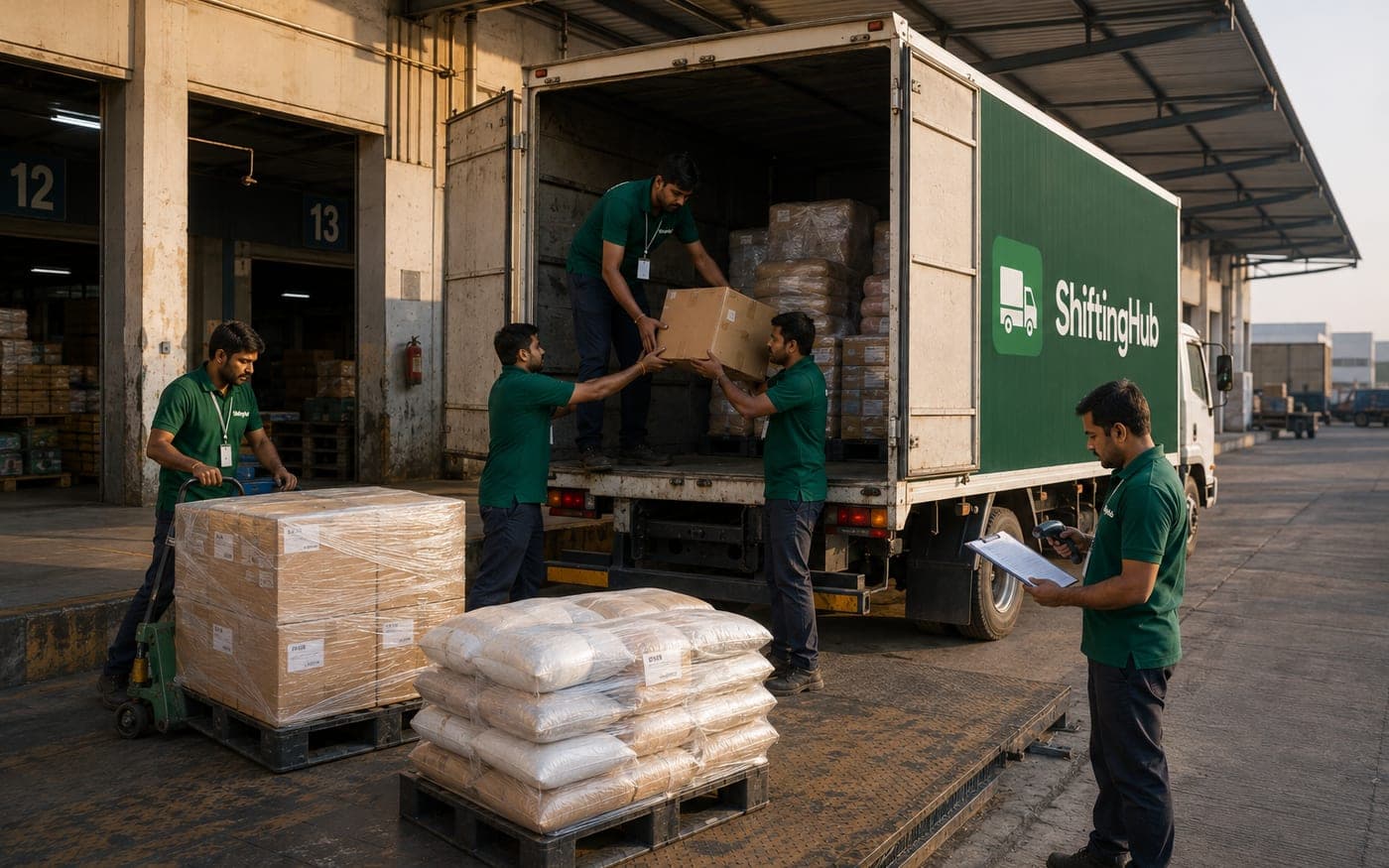
Cargo & Freight
Our freight partners move commercial goods across India on part-load or full-truck consignments. E-way bills, tracking, and scheduling are handled on your behalf.
Get a Free QuoteWhat's included
- Part-load (LTL) & full-truck (FTL) options
- E-way bill documentation support
- Pan-India route coverage
- Real-time consignment tracking
- Cold-chain options available
- Commercial transit insurance
How it works
- 01
Consignment Details
Specify weight, dimensions, commodity type, and pickup/delivery addresses.
- 02
Rate & Route Confirmation
We match you with the best carrier for your lane at a transparent rate.
- 03
Pickup & Loading
Our partner collects from your facility and loads under supervision.
- 04
Delivery & POD
Goods delivered to destination with a signed proof-of-delivery.
Verified partners for cargo & freight
A sample of our verified network. Compare all of them on the partners page.






Commercial freight and cargo transport across India
Moving commercial goods reliably is less about the truck and more about the documentation, the tracking, and the proof-of-delivery that closes out each consignment cleanly. Businesses turn to freight and cargo transport for everything from routine inventory transfers between warehouses to one-off bulk shipments for a new distribution point. ShiftingHub connects you with freight partners who handle both part-load and full-truck consignments, generate e-way bills on your behalf, and provide real-time tracking so a shipment's status is never a mystery mid-route. Safety in commercial freight means proper loading under supervision and a signed proof-of-delivery at the other end, not just a driver's word that everything arrived. Transparency follows the same principle, with quotes based on weight, volume, and route rather than a rounded-up guess.
Why choose ShiftingHub for cargo and freight
Commercial shipping has less room for ambiguity than a household move, since a delayed or damaged consignment usually has a customer waiting on the other end.
- Carrier partners are background-checked, GST-verified, and physically audited before listing.
- Multiple quotations for your specific lane, comparing part-load and full-truck pricing.
- Transparent pricing based on weight, volume, and route rather than a flat guess.
- Comparing quotes across matched carriers can meaningfully reduce recurring freight costs.
- A pan-India network covering both major freight corridors and smaller routes.
- Dedicated account support and commercial insurance assistance throughout.
How the cargo transport process works
- 1.Submit your consignment details: weight, dimensions, commodity type, and addresses.
- 2.Compare quotations and choose between part-load and full-truck options.
- 3.Select a carrier based on rate, route experience, and reliability.
- 4.Goods are collected from your facility and loaded under supervision.
- 5.Real-time tracking lets you follow the consignment through transit.
- 6.Delivery includes a signed proof-of-delivery at the destination.
- 7.Support stays available for any post-delivery follow-up or claim.
What affects cargo transport pricing
- Weight and volume of the consignment.
- Part-load versus full-truck load, since a dedicated vehicle costs more than shared space.
- Distance and the specific route or corridor.
- Commodity type, including whether cold-chain or fragile handling is needed.
- Insurance coverage level relative to the cargo's declared value.
- Scheduling, since same-day pickup can cost more than a planned booking.
Work out a rate for your next consignment.
Estimate freight costTips for smoother freight bookings
- Declare the commodity type accurately, since misdeclared cargo causes delays and disputes.
- Have your invoice and e-way bill documentation ready before pickup.
- Choose full-truck load for time-sensitive or high-value shipments.
- Mention cold-chain requirements upfront if goods are temperature-sensitive.
- Note any damage on the proof-of-delivery immediately, not after the driver leaves.
- Set up a recurring pickup schedule if freight is a regular part of your operations.
Common cargo transport challenges and how they're solved
Multi-drop shipments can add delay if stops aren't planned efficiently, and traffic on congested freight corridors affects timelines during peak dispatch seasons. Hidden costs often trace back to underdeclared weight or dimensions at booking, and damage disputes are harder to resolve without a documented handover at both ends. ShiftingHub's verified carriers address this with transparent quotes based on accurate declared details, real-time tracking that flags delays as they happen, a signed proof-of-delivery for every consignment, and commercial insurance that covers genuine transit loss or damage.
Cargo and freight transport across India
Freight lanes connect Ahmedabad, Vadodara, and Surat with Mumbai, Pune, Delhi, Bengaluru, Hyderabad, Chennai, and Kolkata, covering both dense metro corridors and secondary routes that smaller businesses rely on. Whether you're shipping a single part-load consignment or running regular full-truck dispatches, verified carriers on your specific lane can be compared before you commit.
Setting up recurring freight instead of one-off bookings
Businesses that ship regularly, whether that's weekly stock transfers between warehouses or routine dispatch to a distribution partner, usually get better outcomes from setting up a recurring pickup arrangement rather than booking each consignment individually. A regular schedule gives your carrier partner predictable volume to plan around, which often translates into more consistent pricing and fewer last-minute availability issues during busy periods. It also simplifies your own operations, since your team isn't re-submitting the same consignment details and re-confirming a rate every single time a shipment goes out.
Setting this up usually starts with a conversation with your account contact about your typical shipping pattern: frequency, average weight and volume, and the routes you use most. From there, a standing rate and pickup window can be agreed, with individual shipments confirmed against that arrangement rather than negotiated fresh each time. This is worth discussing even if your volume is currently modest, since most partners are happy to build in flexibility to scale the arrangement up as your shipping needs grow.
Good questions to ask before booking a carrier
- Does the quote already include e-way bill support, or is that billed separately?
- What is the carrier's typical transit time for this exact route, not just a general estimate?
- How is damage handled if it's found only after the proof-of-delivery is signed?
- Is cold-chain or fragile handling available on this lane if you need it later?
- What happens to pricing if your actual weight or volume differs slightly from the quote?
Businesses that treat freight as a planned, recurring process rather than a one-off booking tend to get more consistent pricing and fewer surprises on the road.
Need somewhere to hold inventory between shipments?
See warehouse & B2B storageFrequently asked
What is the minimum consignment weight?
Part-load bookings start from 100 kg. Full-truck loads start from 1 tonne.
Do you handle fragile or high-value cargo?
Yes. Declare the commodity at booking and our partners will arrange appropriate packaging and insurance.
How much does cargo transport cost per kilometre?
Cargo transport pricing is generally quoted as a total for the consignment rather than a strict per-kilometre rate, since weight, volume, commodity type, and whether it is part-load or full-truck load all factor into the final number. Longer routes obviously cost more overall, but the per-kilometre rate tends to drop slightly on longer hauls compared to short local runs. Requesting a quote with your exact weight, dimensions, and route gives you the clearest, most accurate figure.
What is the difference between part-load and full-truck load?
Part-load, sometimes called LTL, means your consignment shares truck space with other shipments heading the same general direction, which usually costs less but may involve a few extra stops along the route. Full-truck load, or FTL, means the entire vehicle is dedicated to your shipment, which typically moves faster and is better suited to larger volumes or time-sensitive cargo. Your partner can advise which option makes more sense based on your shipment size and delivery timeline.
Do you provide e-way bill assistance for shipments?
Yes, e-way bill documentation support is included as part of the freight service, helping you stay compliant for shipments that legally require one under GST rules. Your partner can guide you through generating or confirming the correct e-way bill details based on your consignment value and route, which reduces the risk of delays at checkpoints due to missing or incorrect paperwork. This is particularly useful for businesses that do not regularly ship freight and are less familiar with the process.
How is cargo tracked during transit?
Real-time consignment tracking is available so you can monitor your shipment's progress from pickup through to delivery rather than waiting for a call once it arrives. This is especially useful for businesses managing multiple shipments or working with delivery deadlines tied to customer commitments. Your account contact can also provide manual status updates if you would prefer that over checking tracking directly, giving you flexibility in how closely you want to follow the shipment.
Can perishable goods be transported using cold-chain options?
Yes, cold-chain transport options are available for temperature-sensitive goods, using refrigerated or insulated vehicles to maintain the required temperature range throughout transit. This is important for perishable food items, certain pharmaceuticals, or other goods that degrade outside a specific temperature window. Mention your cold-chain requirements clearly when requesting a quote, since not every route or vehicle in the network is equipped for it, and advance planning ensures the right vehicle is available for your shipment.
What documents are needed to book a freight consignment?
You will typically need an invoice or delivery challan describing the goods, weight and dimension details, and an e-way bill where applicable based on shipment value. Business shipments may also need GST registration details for proper documentation. Your partner will confirm the exact document requirements based on your specific commodity type and route, since certain goods categories carry additional documentation requirements beyond the standard set.
Is insurance included for commercial cargo?
Yes, commercial transit insurance is included for freight shipments, covering damage or loss during transport. Coverage can be adjusted based on the declared value of your cargo, which matters for higher-value commercial shipments. Discuss your specific coverage needs with your partner at booking, particularly if you are shipping fragile, high-value, or specialised goods where standard coverage limits may not fully reflect the shipment's actual worth.
Do you offer scheduled or same-day freight pickup?
Scheduled pickup is standard and lets you plan around a confirmed time window, while same-day pickup may be available depending on carrier availability in your city at the time of your request. For businesses with recurring shipping needs, setting up a regular scheduled pickup arrangement is usually more reliable and cost-effective than booking same-day each time. Ask your account contact about setting up a recurring pickup schedule if freight shipping is a regular part of your operations.
Can you handle bulk shipments for e-commerce businesses?
Yes, bulk freight shipments for e-commerce and retail businesses are handled regularly, whether that is inventory moving between warehouses or bulk stock heading to a distribution point. For businesses needing ongoing inventory management alongside transport, pairing freight with our warehouse and B2B storage service can streamline operations further, since goods can be received, catalogued, and dispatched from a single facility rather than juggling separate transport and storage vendors.
What happens if cargo is damaged in transit?
If damage is found at delivery, it should be noted on the proof-of-delivery document immediately and reported to your partner right away. Since commercial transit insurance is included, a claim can then be filed to cover the loss, based on the declared value of the goods at booking. Reporting damage promptly at the point of delivery, with photos where possible, keeps the claims process fast and straightforward.
Do you provide packaging for commercial goods?
Packaging support can be arranged for commercial shipments, particularly for fragile or irregularly shaped goods that need custom crating or additional cushioning beyond standard commercial packaging. For straightforward palletised or boxed freight, your existing packaging is typically sufficient as long as it meets standard transport handling requirements. Mention any unusual packaging needs when requesting your quote so the right materials and handling are planned in advance.
Can cargo be delivered to multiple destinations in one booking?
Yes, multi-drop shipments where a single consignment needs to be delivered to more than one destination can be arranged, common for businesses distributing stock to multiple stores or warehouses. This is typically priced slightly differently from a single-destination shipment since it involves additional stops and handling. Share your full delivery list when requesting a quote so the route and pricing can be planned accurately from the start.
Is there a weight limit for full-truck loads?
Full-truck loads are generally available starting from around 1 tonne, with capacity scaling up based on the specific vehicle type booked for your route, up to standard commercial vehicle weight limits. If your shipment exceeds standard truck capacity, multiple vehicles or a specialised heavy-cargo vehicle can be arranged instead. Share your total weight and dimensions when requesting a quote so the right vehicle type is matched to your consignment.
How far in advance should I book a freight consignment?
For standard part-load or full-truck shipments, a few days notice is usually sufficient, though booking earlier tends to get you better vehicle availability and pricing, especially during busier shipping periods. For cold-chain, oversized, or multi-drop shipments, more advance notice, ideally a week or more, helps ensure the right specialised vehicle is available for your specific requirements rather than settling for whatever is on hand at short notice.
Do you offer warehousing along with freight transport?
Yes, freight transport can be paired with our warehouse and B2B storage service, which is useful for businesses that need somewhere to hold inventory between shipments or before final distribution. Combining transport and warehousing under one coordinated arrangement simplifies operations, since goods can move seamlessly from storage to transport without needing to manage two entirely separate vendor relationships and schedules.
Can you transport hazardous or restricted goods?
Certain hazardous materials require specialised licensing, vehicles, and documentation that not every route or partner can support, so this needs to be discussed directly and clearly at the time of booking rather than assumed. Standard restricted items like unlicensed flammables or certain chemicals may not be transportable at all through standard freight channels. Declare the exact nature of your cargo upfront so your partner can confirm whether and how it can be safely and legally transported.
Ready to book cargo & freight?
Get matched with a verified partner and a transparent quote instantly.