Industrial & Factory Moving
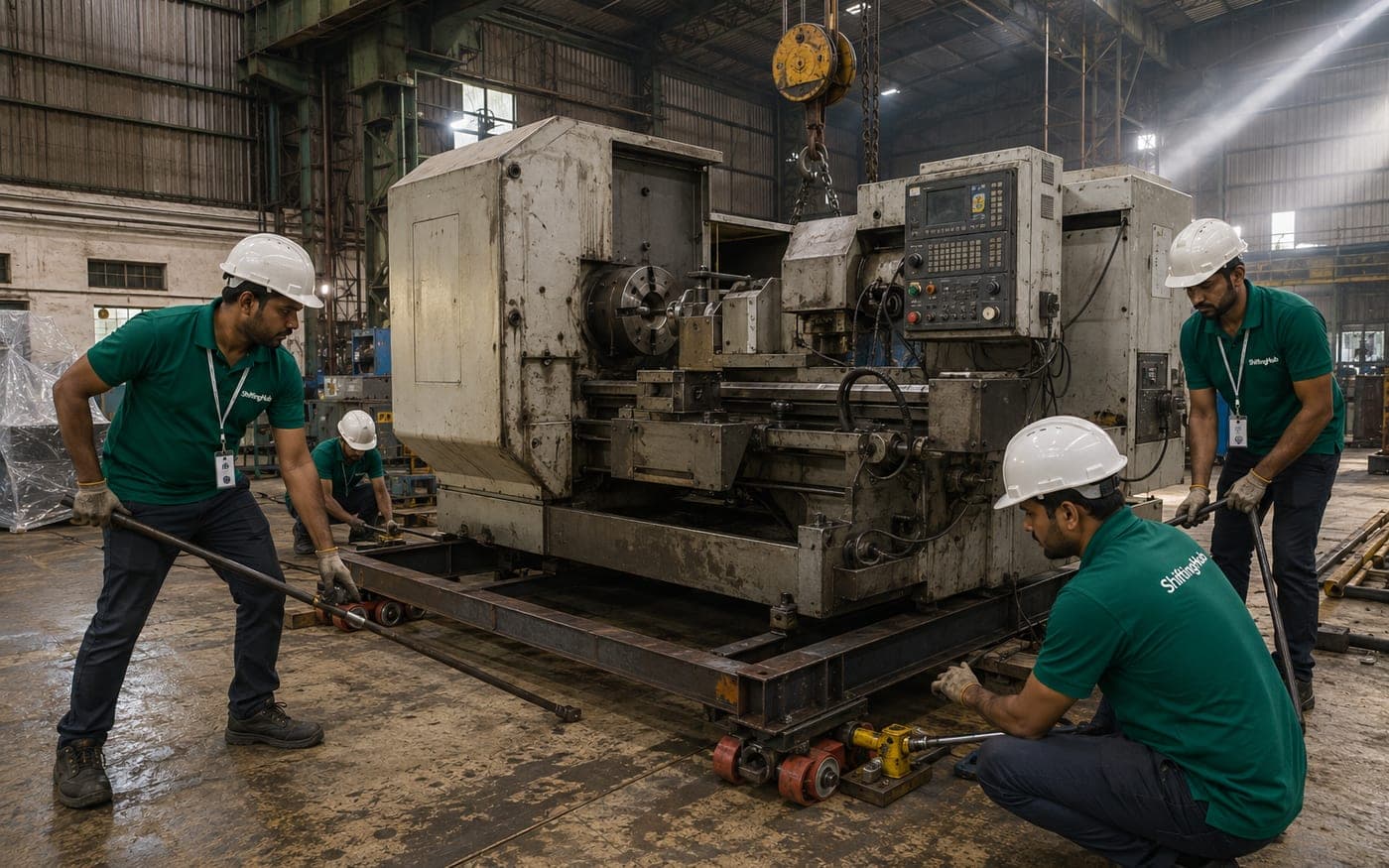
Moving a CNC machine or an entire factory floor takes cranes, flatbed transport, and a site engineer at both ends. Our industrial partners handle rigging, transit, and recommissioning.
Get a Free QuoteWhat's included
- Heavy-lift cranes & forklifts
- Floor anchor removal & reinstallation
- Flatbed & low-loader transport
- Machinery rigging specialists
- Factory floor layout planning
- Minimum production downtime
How it works
- 01
Site Survey & Planning
Engineers assess machine weight, dimensions, and access routes at both sites.
- 02
Decommissioning
Machines are safely powered down, disconnected, and floor anchors removed.
- 03
Heavy-Lift Transport
Specialist flatbed or low-loader vehicles move equipment under escort.
- 04
Reinstallation & Commissioning
Machines are reinstalled, aligned, and tested at the new facility.
Verified partners for industrial & factory moving
A sample of our verified network. Compare all of them on the partners page.







Plant relocation and heavy machinery moves, engineered properly
Moving a CNC machine or an entire factory floor is a different category of work from an office move, involving cranes, flatbed transport, and a site engineer at both ends who understands rigging, floor anchors, and calibration tolerances. Factories relocate for all kinds of reasons: outgrowing a facility, consolidating two plants into one, or chasing a better lease, and in every case the equipment involved is expensive enough that a poor lift or a rushed reinstall carries real cost. ShiftingHub's industrial partners plan the move around your machinery's actual weight, dimensions, and access routes, using rigging specialists rather than general labour. Safety is the entire premise of this service, from a properly planned lift to permits for oversized loads on the road. Transparency follows the same logic: pricing comes after a site survey, not a guess over the phone.
Why choose ShiftingHub for industrial moving
Heavy machinery doesn't forgive shortcuts, which is why this category of move needs partners who specialise in it.
- Partners with genuine rigging and crane experience, verified and audited before listing.
- Multiple quotations after a proper site survey of both locations.
- Transparent, scope-based pricing that reflects machine weight and access complexity.
- Comparing quotes across matched partners can meaningfully reduce project cost.
- A nationwide heavy-lift network covering both local and interstate industrial moves.
- A dedicated project engineer and insurance assistance for high-value equipment throughout.
How the industrial moving process works
- 1.Submit your machine details: weight, dimensions, and site information for both locations.
- 2.Compare quotations from partners with relevant rigging and heavy-lift experience.
- 3.Select a partner and agree on a production shutdown or off-hours window.
- 4.A site survey and decommissioning plan is finalised before any machine is touched.
- 5.Heavy-lift transport moves equipment under permit, using flatbed or low-loader vehicles.
- 6.Machines are reinstalled, realigned, and floor-anchored at the new site.
- 7.Post-move commissioning and testing confirm equipment is running within tolerance.
What affects industrial moving costs
- Machine weight and dimensions, which determine the rigging and crane needed.
- Permits required for oversized or overweight loads, especially across state lines.
- Distance between the current and new facility.
- Insurance coverage level relative to the declared value of the machinery.
- Labour required for decommissioning, floor anchor removal, and reinstallation.
- Whether escort vehicles are required for particularly large loads.
Scope your plant move before committing to a shutdown date.
Estimate industrial moving costTips for planning an industrial relocation
- Start planning four to six weeks ahead to allow time for permit processing.
- Document machine calibration and settings before disconnection.
- Confirm floor anchor and foundation specifications at the new site in advance.
- Ask about escort vehicles if your equipment counts as an oversized load.
- Keep your own engineer present during reinstallation and testing.
- Insure machinery at true replacement value, not a rounded estimate.
Common industrial moving challenges and how they're solved
Permit processing for oversized loads can take longer than expected, which is why lead time matters more here than in almost any other service. Production downtime pressure is constant, since every day a line sits idle has a real cost, and reinstallation risk is real too, since a machine that isn't realigned or floor-anchored correctly can fail calibration checks. Demand can also spike when several businesses plan shutdowns around the same festive or financial year-end window. ShiftingHub addresses this with a survey-first process that surfaces permit and access issues early, licensed riggers who plan lifts around the machine's actual centre of gravity, and documented decommissioning that keeps reinstallation predictable.
Industrial moving across India's manufacturing belts
Rigging and heavy-lift partners operate across the industrial belts of Ahmedabad, Vadodara, and Surat, alongside the manufacturing corridors around Mumbai, Pune, Delhi NCR, Bengaluru, Hyderabad, Chennai, and Kolkata. Whether it's a single machine moving within the same industrial estate or a full plant relocating across states, the same engineering-led process applies regardless of scale.
Working with your operations team through the move
An industrial relocation runs smoothest when your own operations and maintenance staff are treated as part of the project team rather than bystanders waiting for a handover. They know the quirks of specific machines, which settings tend to drift after a shutdown, and which components have needed repair before. Sharing this knowledge with the rigging and engineering team during the site survey often surfaces details a generic assessment would miss, like a machine that needs a slightly different lifting point than its listed specifications suggest. Many businesses assign a single internal point of contact, often a maintenance lead, to work alongside the relocation partner's project engineer throughout decommissioning, transport, and reinstallation.
This collaboration matters most during recommissioning, when machines are powered on and tested. Having someone who runs that equipment daily present for testing catches subtle issues, like a slightly off calibration or an unusual sound, that a relocation team focused on the physical move might not recognise as a problem worth flagging.
The industrial moves that go smoothly are almost always the ones where the site survey happened early enough to catch permit and access issues before they became a delay.
Need finished goods moved separately from the machinery?
See cargo and freightFrequently asked
What is the maximum machine weight you can move?
Our partner network handles single items up to 50 tonnes with appropriate heavy-lift equipment.
Do you handle electrical and plumbing reconnection?
We coordinate with your in-house engineers or can arrange licensed contractors for reconnection.
How much does industrial machinery relocation cost?
Industrial relocation pricing depends on machine weight, dimensions, the equipment needed for rigging and lifting, and the distance between sites, so it is always quoted after a site survey rather than a flat rate. A single CNC machine move within the same city costs considerably less than relocating an entire factory floor across states. Your partner's engineers assess access routes, machine weight, and any crane requirements before providing a detailed, itemised quote covering decommissioning, transport, and reinstallation.
Do you provide cranes and rigging equipment for heavy machines?
Yes, heavy-lift cranes, forklifts, and rigging equipment are arranged as part of the industrial moving service, sized appropriately to your specific machinery's weight and dimensions. Rigging specialists plan the lift sequence in advance, accounting for the machine's centre of gravity and any fragile components, rather than treating it like a standard furniture lift. This specialised equipment is why industrial moves are handled by dedicated partners rather than a general household or office moving team.
How is production downtime minimised during a factory move?
Downtime is reduced by careful sequencing: less critical machines or lines are often relocated first as a trial run, while production-critical equipment moves last and is prioritised for fastest reinstallation and testing. Weekend or planned shutdown windows are typically used to avoid interrupting an active production schedule. A detailed pre-move plan, built during the site survey, maps out this sequence so your operations team knows exactly what to expect and when each line will be back online.
Can you dismantle and reinstall CNC machines?
Yes, CNC machines and similar precision equipment are dismantled by engineers who understand their specific mechanical and electrical connections, not just general labour. Floor anchors are removed, and any calibration-sensitive components are documented before disassembly. At the new site, machines are reinstalled, realigned, and floor-anchored again, followed by testing to confirm they are running within the original calibration tolerances before being handed back to your team for production use.
Is insurance available for heavy machinery in transit?
Yes, transit insurance for industrial equipment can be arranged based on the declared value of your machinery, which matters significantly given how expensive specialised equipment typically is. Coverage details should be discussed with your partner during the site survey, particularly for machines that would be costly or slow to replace if damaged. A documented pre-move condition report for each major machine also supports a smoother claims process if anything were to go wrong during transit.
What permits are needed to transport oversized equipment?
Oversized or overweight machinery transported by road often requires special permits depending on the dimensions and the states the route passes through. Your partner's team handles this documentation on your behalf, including any escort vehicle requirements mandated for particularly large loads. This paperwork can take time to process, which is one of the main reasons industrial moves need to be planned well in advance rather than booked at short notice.
Do you conduct a site survey before an industrial move?
Yes, a site survey is standard practice and typically involves engineers visiting both the current and new locations to assess machine weight, dimensions, access routes, doorway and lift clearances, and any structural considerations at either site. This survey directly shapes the equipment plan, from crane sizing to vehicle selection, and forms the basis of your written quote. Skipping this step is not really an option for equipment of any real size or complexity.
Can you relocate an entire factory floor at once?
Yes, full factory floor relocations are handled as larger coordinated projects, often broken into phases so production can restart gradually rather than everything being offline simultaneously. This involves detailed planning around machine sequencing, crane and vehicle scheduling, and reinstallation order at the new facility. Given the scale, these projects typically need a longer lead time and closer coordination between your operations team and the relocation partner's project engineer throughout the process.
How are floor anchors and foundations handled?
Floor anchors are carefully removed during decommissioning, and any resulting floor damage at the original site is documented. At the new facility, machines are reinstalled and re-anchored according to the manufacturer's specifications and the new floor's structural characteristics, which sometimes requires coordination with a structural engineer if the flooring differs significantly from the original site. This attention to anchoring is part of what keeps heavy machinery stable and safe once it is back in operation.
Do you provide escort vehicles for oversized loads?
Yes, escort vehicles are arranged when required by regulation for oversized or overweight loads, helping manage traffic and route navigation safely, particularly through narrow sections or tight turns. This is coordinated alongside the permits needed for the same load, since both requirements typically apply together for genuinely oversized equipment. Your partner handles this logistics planning as part of the overall move, so you are not separately sourcing escort services yourself.
Can machines be tested after reinstallation?
Yes, machines are powered on and tested after reinstallation to confirm they are functioning and, where relevant, running within expected calibration tolerances before being handed back for production use. For highly specialised or precision equipment, your own technical team is often present during this testing phase to run their own checks alongside the relocation engineers. This joint verification step is there specifically to catch any issues before the machine goes back into active production.
What safety measures are followed during heavy lifting?
Rigging plans account for the machine's weight distribution and centre of gravity before any lift begins, and lifting equipment is matched to the specific load rather than used generically. The lift area is cleared and controlled during the operation, with trained riggers directing the process rather than general labour. These precautions exist because a poorly planned heavy lift risks damage to the equipment, the site, and most importantly, the safety of everyone involved in the move.
How far in advance should an industrial move be planned?
For most industrial relocations, four to six weeks of lead time is a reasonable starting point, given the site survey, permit processing for oversized loads, and crane or rigging equipment scheduling all involved. Larger factory floor relocations or moves involving interstate permits may need even longer. Reaching out early, even before you have finalised every detail, lets the planning process start sooner and generally results in a smoother, better-coordinated move overall.
Can you move machinery across state borders?
Yes, interstate industrial relocation is handled with the additional permits and documentation that oversized or heavy loads require when crossing state lines. Route planning accounts for road conditions, weight restrictions on certain highways, and any state-specific regulations that might apply to the specific type of machinery being transported. This adds planning time compared to a local industrial move, so factor in extra lead time if your relocation crosses state borders.
Do you handle packaging for delicate industrial components?
Yes, sensitive components like sensors, control panels, and precision parts are packaged separately from the main machine body using foam-lined crating or anti-vibration padding, rather than being left attached during transport where possible. This reduces the risk of misalignment or damage to delicate parts during the journey. Your partner's engineers will identify which components need this separate handling during the site survey, based on the specific machine and its known sensitive points.
Is on-site engineering support available during the move?
Yes, industrial relocations are typically overseen by a project engineer who is present on-site during decommissioning, transport coordination, and reinstallation, rather than just general moving labour running the job. This engineering oversight matters for machinery where incorrect handling or reassembly could cause real functional or safety issues. Your operations team can coordinate directly with this on-site engineer throughout the project for a single, technically informed point of contact.
Ready to book industrial & factory moving?
Get matched with a verified partner and a transparent quote instantly.