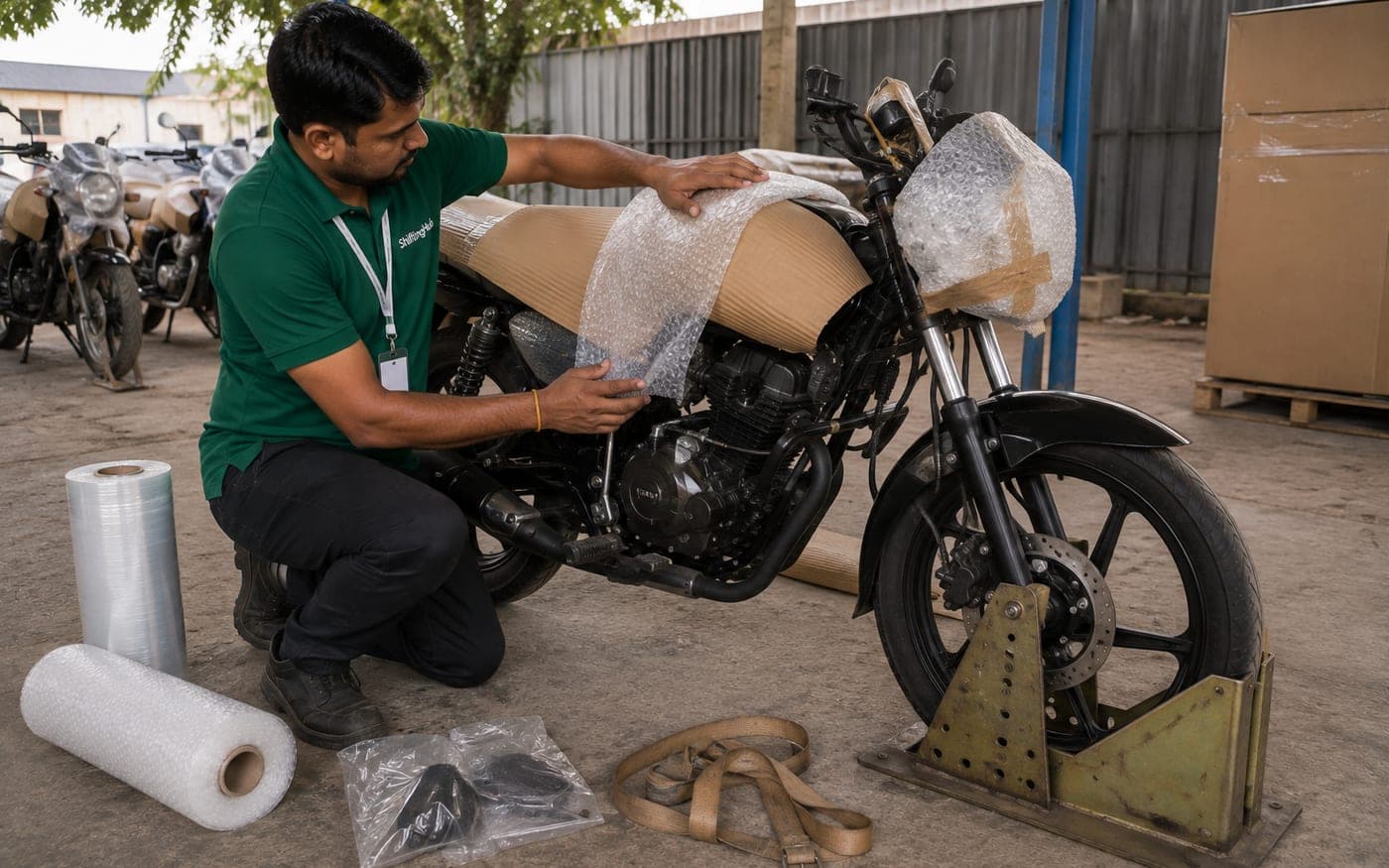
Bike Transportation
Your bike, commuter or vintage, travels in an enclosed carrier with GPS tracking and insurance from pickup to delivery. Both ends are inspected and signed off.
Get a Free QuoteWhat's included
- Enclosed carrier transport
- Real-time GPS tracking
- Insurance up to ₹1 lakh
- Doorstep pickup & delivery
- All bike types: commuter to sports
- Pre & post delivery inspection
How it works
- 01
Booking & Inspection
We photograph your bike and document its condition before pickup.
- 02
Secure Loading
Your bike is secured with soft-tie straps inside an enclosed carrier.
- 03
GPS-Tracked Transit
Track your two-wheeler live throughout the journey.
- 04
Delivery & Sign-Off
Final inspection at your doorstep. Any discrepancy is logged and actioned.
Verified partners for bike transportation
A sample of our verified network. Compare all of them on the partners page.







Safe bike transport for every kind of two-wheeler
A bike takes a different kind of care than a car during transport, since it has no roof and fewer contact points holding it steady on a carrier. Safe bike transport means soft-tie strapping instead of rigid clamps, an enclosed carrier when the bike is premium or vintage, and a documented condition report before pickup that gives you something concrete to compare against at delivery. People book bike transport for all kinds of reasons, from a job relocation to buying a bike in another city and needing it delivered home. ShiftingHub connects you with two-wheeler transport partners who run GPS-tracked carriers and doorstep pickup, so the bike leaves from your address and arrives at the new one without you needing to ride it across states yourself. Transparency shows up as route-based pricing that separates distance, bike type, and carrier choice clearly upfront.
Why choose ShiftingHub for bike transport
A two-wheeler is easy to underestimate until it needs to travel five hundred kilometres safely.
- Carrier partners are background-checked, GST-verified, and physically audited before listing.
- Multiple quotations by route, comparing open and enclosed carrier pricing.
- Transparent pricing that separates distance, bike type, and carrier choice.
- Comparing quotes rather than the first transporter you find can save up to 30%.
- A nationwide network covering both metro routes and smaller city pairs.
- Support and insurance assistance from booking through to delivery sign-off.
How the bike transport process works
- 1.Submit your bike details and route: model, pickup city, and destination.
- 2.Compare quotations from matched partners, including carrier type and delivery speed.
- 3.Select a partner based on price, timeline, and rating.
- 4.A pre-pickup inspection photographs and documents the bike's condition.
- 5.The bike is secured with soft-tie straps inside an enclosed or open carrier.
- 6.GPS-tracked transit lets you follow the journey through to delivery.
- 7.A final inspection at delivery confirms condition, with any discrepancy logged immediately.
What affects bike transport pricing
- Distance between the pickup and delivery cities.
- Bike type and size, since larger or heavier bikes take more carrier space.
- Open versus enclosed carrier transport.
- Whether the bike is running or needs winch-assisted loading.
- Insurance coverage level relative to the bike's value.
- Standard versus express delivery timelines.
See what your route and bike type add up to.
Estimate bike transport costTips for a smoother bike transport experience
- Photograph the bike from every angle before pickup, including any existing marks.
- Drain the fuel tank to a low level before the carrier arrives.
- Remove loose accessories, helmets, and anything valuable from the bike.
- Choose an enclosed carrier for premium, vintage, or newly purchased bikes.
- Confirm the insurance limit actually matches your bike's value.
- Check a transporter's reviews and rating before confirming your booking.
Common bike transport challenges and how they're solved
Longer interstate routes bring their own risks: weather can slow delivery by a day, festive-season demand tightens carrier availability, and damage disputes are common when there's no documented starting condition. Unverified transporters sometimes add hidden charges for non-running bikes that weren't declared at booking. ShiftingHub's verified partners handle this with a documented pre-pickup inspection, transparent pricing that accounts for bike condition from the start, GPS tracking that flags delays proactively, and insurance that covers genuine transit damage rather than leaving you to argue a claim alone.
Bike transport across India
Verified two-wheeler transporters cover routes between Ahmedabad, Vadodara, and Surat and destinations including Mumbai, Pune, Delhi, Bengaluru, Hyderabad, Chennai, and Kolkata. Both frequently travelled corridors and less common city pairs are supported, so a bike headed to a smaller destination city gets the same standard of tracking and insurance as one headed to a major metro.
Standard delivery versus express: which one to choose
Most bike transport bookings use standard delivery, where road time follows the distance at a 50 to 60 km/h average and carrier scheduling can add a day at each end. That works well when you're not relying on the bike immediately after arriving in a new city. Express delivery, arriving in roughly 48 hours, costs more but makes sense if you need the bike for a job that starts almost immediately, or if you'd rather avoid renting or borrowing transport in the new city for more than a day or two. Availability for express delivery depends on carrier scheduling for your specific route, so it's worth asking about it as soon as you know your moving date rather than assuming it's always an option.
If timing isn't urgent, standard delivery is usually the more economical choice, and the extra day or two rarely matters much in practice. Where it does matter is if you're coordinating the bike's arrival with your own travel dates, in which case confirming the exact delivery window with your partner in advance avoids a mismatch between when you arrive and when your bike does.
Good questions to ask before booking a bike transporter
- Is the carrier open or enclosed, and does that match what was quoted?
- What's covered under the insurance limit, and does it match your bike's actual value?
- How is a non-running bike loaded, and does that change the price or timeline?
- What documentation will be needed at pickup versus at delivery?
- Is express delivery genuinely available on this specific route, or only on paper?
Comparing a couple of verified quotes side by side, rather than picking whoever answers the phone first, is usually what keeps a bike transport booking free of surprises.
Also moving a car on the same route?
Check vehicle transportFrequently asked
How long does bike transport take?
Road time follows the distance at a 50 to 60 km/h average, and carrier scheduling at pickup and delivery can add a day at each end. Express 48-hr delivery is available at a premium.
Can I put accessories or a helmet inside the carrier?
Small accessories can be secured, but we recommend removing fuel and transporting detachable parts separately.
How much does bike transport cost?
Bike transport pricing typically starts around ₹3,400 for shorter routes and scales up with distance, reaching roughly ₹13,000 for longer interstate hauls of around 1,500 km. Pricing depends mainly on distance and bike type, with heavier or larger bikes sometimes costing a little more due to their size on the carrier. A quick quote based on your pickup and delivery cities, along with your bike model, gives you an exact figure before you book.
Is insurance included for bike transport?
Yes, transit insurance is included as standard on bike transport bookings, with coverage up to ₹1 lakh depending on the partner and plan. This protects against damage that may occur during loading, transit, or unloading. For premium or high-value bikes worth more than the standard coverage limit, ask your partner about enhanced insurance options so the coverage properly reflects your bike's actual value rather than defaulting to a standard limit that might not be enough.
What packing methods are used to protect the bike?
Bikes are secured inside an enclosed carrier using soft-tie straps rather than rigid clamps, which protects the frame, tank, and bodywork from pressure marks or scratches during transit. Mirrors, indicators, and other protruding parts are often wrapped or removed and packed separately if they are at risk of getting knocked. A pre-pickup inspection documents the bike's condition with photos, giving both you and the carrier a clear reference point to compare against at delivery.
Can premium bikes be transported safely?
Yes, premium and superbikes are transported using enclosed carriers that protect them from weather, dust, and road debris throughout the journey, along with extra care during loading and securing given their higher value and often larger dimensions. A more detailed inspection report is usually recommended for premium bikes, documenting even minor existing marks before pickup. It is worth discussing enhanced insurance coverage with your partner given the typically higher replacement cost of these bikes.
What documents are required for bike transportation?
You will typically need the bike's registration certificate, a valid insurance copy, and a government ID matching the name on the registration. If the bike belongs to someone else, a signed authorisation letter is generally required. For interstate transport, having your PUC certificate available can help avoid delays at any checkpoint along the route. Your partner will confirm the full document list specific to your route at the time of booking.
Is doorstep pickup available for bike transport?
Yes, doorstep pickup and delivery is the standard for bike transport, meaning the carrier collects your bike directly from your address and delivers it to the destination address rather than a depot you would need to travel to. In areas with narrow lanes or restricted vehicle access, the carrier may need to park nearby and complete the last short stretch on foot or by riding the bike a short distance, which your partner will flag in advance if relevant.
What cities are covered under bike transport?
Bike transport is available across the same broad network ShiftingHub covers for other services, spanning major metros and many tier-2 cities across India. Coverage tends to be strongest on well-travelled routes, though less common city pairs can often still be arranged. When requesting a quote, enter your specific pickup and delivery cities to see which verified partners are currently active and available on that exact route.
Can electric bikes be transported?
Yes, electric bikes and scooters can be transported, though it helps to mention the battery type at booking since some batteries have specific handling or documentation requirements for road transport. The bike itself is secured and protected the same way as a conventional bike, with the added step of ensuring the battery is disconnected or secured appropriately for the journey. Your partner will confirm any electric-vehicle-specific requirements for your particular model before pickup.
How is the bike secured inside the carrier?
The bike is strapped upright or in a stable position using soft-tie restraints anchored to the carrier frame, which keeps it from shifting or tipping during transit, even on longer or bumpier routes. Wheel chocks are often used alongside the straps for extra stability. This is different from simply leaning a bike against the side of a truck, which is how damage tends to happen with unverified or informal local transporters.
Can I transport a bike that isn't in running condition?
Yes, non-running bikes can still be transported, but mention this clearly at booking since loading equipment needs to account for a bike that cannot be ridden onto the carrier under its own power. This may involve a small additional charge and slightly more planning time compared to a standard running bike. Flagging it upfront ensures the right equipment and team arrive on pickup day instead of causing delays.
Is fuel drained from the tank before transport?
It is standard practice to keep the fuel tank at a low level, similar to car transport, since a small amount may be needed to move the bike on and off the carrier but a full tank adds unnecessary weight and risk. Your partner will mention this as part of the pre-pickup checklist. Any loose accessories or valuables should also be removed from the bike before it is loaded onto the carrier.
Do you offer express delivery for bikes?
Yes, express delivery within roughly 48 hours is available on select routes for an additional cost, useful if you need your bike quickly rather than waiting out the standard window, which follows road distance at a 50 to 60 km/h average plus carrier scheduling at each end. Availability depends on carrier scheduling for your specific route, so ask about express options when requesting your quote if timing is a priority for your move.
What happens if my bike is scratched during transit?
If any damage is found at delivery, it is documented against the pre-pickup inspection report immediately, which is why that initial documentation matters. Since transit insurance is included on every booking, a claim can be raised through your partner to cover repair costs for genuine transit damage. Reporting it right at delivery, rather than days afterward, keeps the process fast since there is a clear, timestamped record of the bike's condition at both ends.
Can I transport more than one bike in a single booking?
Yes, multiple bikes can be booked together in a single consignment, which is often more economical than booking them separately since one carrier trip can accommodate more than one bike depending on carrier size. This is common for families or small businesses relocating multiple two-wheelers at once. Mention all the bikes you need transported when requesting a quote so your partner can plan carrier capacity and give you a single combined price.
Is open or enclosed carrier transport available for bikes?
Both options are typically available. Open carrier transport costs less and works fine for everyday commuter bikes on most routes. Enclosed carriers cost more but fully shield the bike from weather and road dust, which is worth considering for premium, vintage, or newly purchased bikes. Your partner can confirm which carrier types are running on your specific route and the price difference before you finalise your booking.
How do I track my bike during transport?
GPS tracking is included on bike transport bookings, letting you follow the journey rather than waiting without updates until delivery. This is especially useful on longer interstate routes spanning several days. Your move coordinator can also share status updates directly if you would rather get a message than check tracking yourself, giving you a clear sense of when to expect your bike at the destination.
Bike Transportation by city
Each city page carries its own prices, local corridors and the partners active there. Pick yours to compare quotes.
Ready to book bike transportation?
Get matched with a verified partner and a transparent quote instantly.